
Life Coach vs. Therapist: What’s the Difference and Which One Is Right for You?
Knowing that something in your life needs to change is not always the same as knowing what kind of support you need. Maybe you are considering a career change but keep talking yourself out of it. You may have goals that matter to you, yet struggle to stay consistent long enough to make real progress. You might feel stretched too thin between work, relationships, family, and everything else competing for your attention. Sometimes life is going relatively well on the surface, but there is still a nagging sense that something feels off or that you are ready for more.
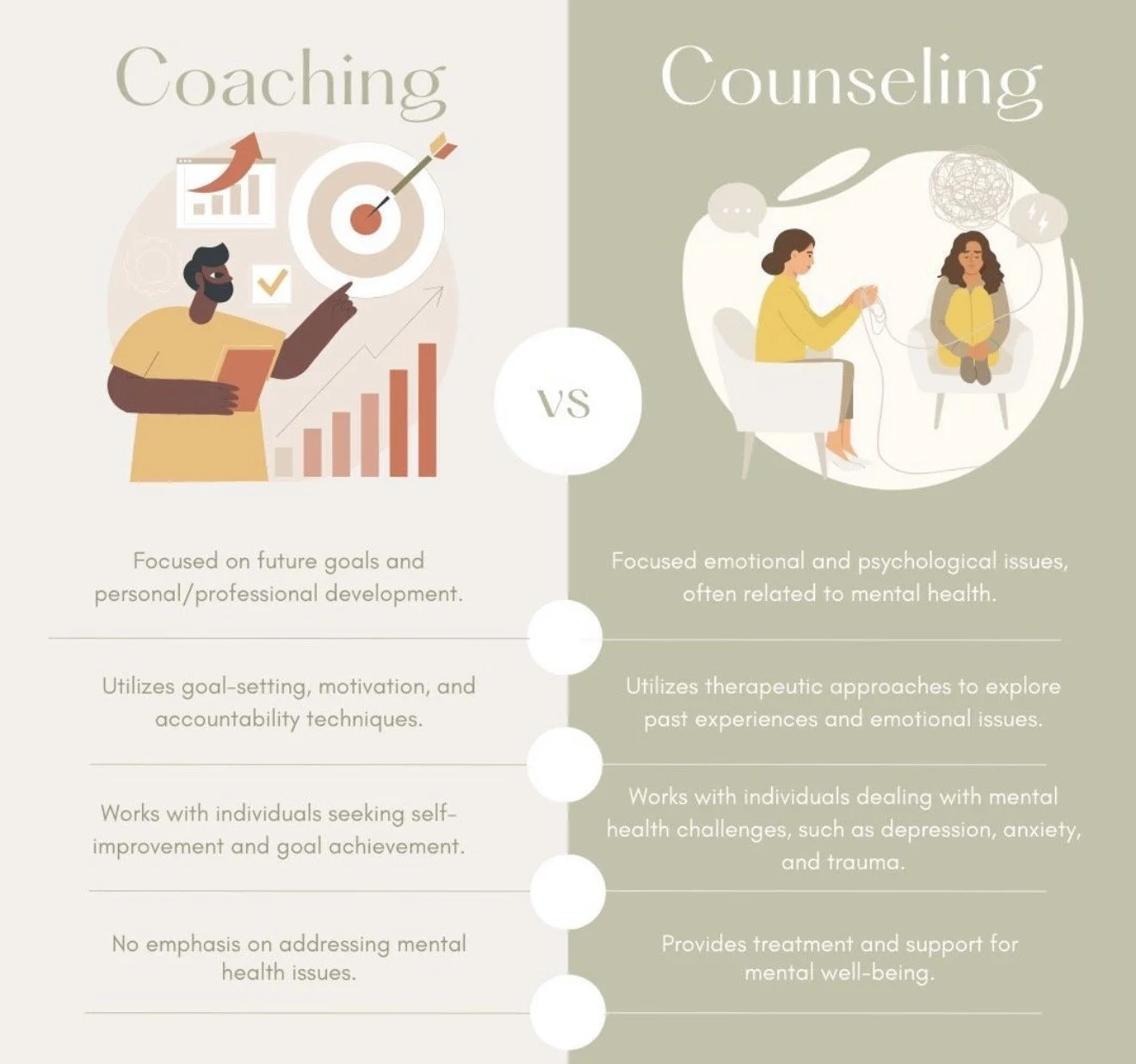
This is often where the question comes up: Do I need a life coach or a therapist? It is a fair question because life coaching and therapy can sound similar from the outside. Both can involve conversations about your goals, relationships, habits, stress, confidence, communication, and major life changes. Both can help you become more self-aware and intentional. The biggest difference is not necessarily the topic being discussed, but the type of support being provided and what you are hoping to accomplish.
What Does a Life Coach Actually Do?
Life coaching is generally focused on helping you identify where you want to go and creating a realistic path for getting there. You do not need to be in crisis or have a major problem to work with a coach. Many people seek life coaching because they feel stuck, scattered, unmotivated, or unsure about what their next step should be. Others already know what they want but need accountability, structure, and an outside perspective to help them follow through.
A life coach may help you work through goal setting, career growth, work-life balance, confidence, communication, healthy boundaries, decision-making, personal development, and major life transitions. Coaching can also be useful when you are trying to build better habits, redefine your priorities, or move past patterns of procrastination and self-doubt that keep slowing you down.
The goal of coaching is not for someone else to tell you what your life should look like. Strong coaching is collaborative. It helps you look honestly at where you are now, what is getting in the way, and what practical steps could move you closer to the life you actually want.
What Does a Therapist Do?
Therapy is a mental health service provided by a licensed professional who is trained to assess and treat emotional, behavioral, and psychological concerns. Someone may seek therapy for anxiety, depression, trauma, grief, significant relationship difficulties, emotional distress, or patterns that are interfering with everyday life. Therapy can also help people understand how past experiences, relationships, beliefs, and coping patterns continue to influence how they feel and respond today.
Therapy is sometimes described as focusing on the past while coaching focuses on the future, but that comparison is too simple. Therapy can be very practical and future-focused, while coaching may also involve reflecting on past experiences that influence current decisions. A more accurate distinction is that therapists have clinical training and a scope of practice that allows them to assess and treat mental health conditions, while life coaching is designed around growth, goals, accountability, and forward movement rather than mental health treatment.
If what you are experiencing is significantly affecting your sleep, relationships, work, daily functioning, safety, or ability to cope, therapy may be the more appropriate place to begin.
Why Life Coaching and Therapy Can Feel Similar
The difference between life coaching and therapy can feel blurry because real life does not separate itself into neat categories. A career decision can bring up self-doubt. A difficult relationship may reveal problems with communication or boundaries. Becoming a parent can change your identity and priorities. Starting a business can challenge your confidence. Feeling burned out at work may make you question what you actually want your life to look like.
Many of these topics could come up in either therapy or coaching. The key difference is often what is happening underneath the problem and what you need from the process.
Consider two people who both say, “I hate my job.” One person may be emotionally exhausted, experiencing significant anxiety, struggling to sleep, and having difficulty functioning outside of work. Therapy may be an important place to address the emotional distress and mental health concerns involved. Another person may be functioning well but knows they have outgrown their current role. They want help identifying what they want next, exploring career options, creating a plan, and staying accountable while making a change. That situation is much more aligned with life coaching.
The surface-level problem can look the same while the need behind it is completely different.
When You Know What You Want but Cannot Seem to Get There
One of the most common reasons people seek a life coach is because they feel caught in the gap between knowing and doing. You may know you need better boundaries but still say yes before thinking about it. You may know you want to make a career move, yet another six months goes by without taking a real step. You may have a long list of goals in your notes app but very little movement happening in everyday life.
This can be especially frustrating because information is not usually the problem anymore. There are podcasts, books, productivity systems, online courses, career advice, goal-setting templates, videos, and AI-generated plans available within seconds. Most people can find endless information about what they could do. What is harder to create on your own is personalized accountability, perspective, and consistent follow-through.
Life coaching can help turn a collection of ideas into an actual plan. Instead of trying ten different strategies at once, coaching can help you identify what matters most, what feels realistic, and what needs to happen next.
Life Coaching During Major Life Transitions
Some seasons of life are not necessarily mental health crises, but they still leave you asking, “What now?” You may have recently graduated, changed careers, moved to a new city, ended a relationship, become a parent, received a promotion, or reached a goal that you worked toward for years. Even positive transitions can disrupt routines, priorities, and the sense of identity that once made life feel predictable.
Life coaching can provide a structured place to think through what this next season could look like instead of simply reacting to whatever comes next. You may explore what matters most to you now, where you want to spend your time and energy, what you are ready to let go of, and what kind of progress would actually feel meaningful over the next few months.
These conversations can be especially helpful for people who feel like they have been operating on autopilot. Sometimes the goal is not a dramatic life overhaul. It is simply becoming more intentional about the direction you are already moving.
Burnout, Work-Life Balance, and the Pressure to Keep Up
Burnout and work-life balance have become major conversations because more people are realizing that being productive is not the same thing as having a life that feels sustainable. You can be successful and still feel constantly behind. You can be dependable and still resent how much everyone depends on you. You can enjoy your career and still recognize that work has slowly taken over time that used to belong to relationships, rest, hobbies, or yourself.
Life coaching can be helpful when you are ready to look at how your schedule, boundaries, expectations, and habits are functioning in everyday life. That may include learning to communicate more directly, deciding what deserves a no, creating more realistic routines, redefining what success means to you, or making a change you have been thinking about for a long time.
If burnout or stress has developed into significant anxiety, depression, emotional distress, or difficulty functioning, therapy may be a better starting point. Coaching can support growth and change, but it should not replace appropriate mental health treatment.
Can You Work With a Life Coach and a Therapist at the Same Time?
For some people, the answer is yes. Life coaching and therapy do not always have to compete with each other because they can serve different purposes. Someone may work with a therapist to address anxiety, grief, trauma, or long-standing emotional patterns while also working with a coach on a specific personal or professional goal.
For example, therapy may help someone better understand anxiety or relationship patterns, while coaching helps that same person create a career development plan, build stronger leadership skills, improve work-life balance, or stay accountable to a specific goal. The important part is that the roles remain clear and that coaching is not used as a substitute for clinical care when therapy is needed.
How to Decide Which Type of Support Fits You
If you are unsure whether life coaching or therapy is right for you, start by thinking about what you are hoping will be different. If you are looking for treatment and support for significant emotional distress, trauma, depression, anxiety, grief, or symptoms that are making everyday life harder to manage, therapy may be the more appropriate option.
If you are functioning relatively well but want help with clarity, accountability, decision-making, personal growth, career development, boundaries, communication, or a major life transition, life coaching may be a better fit. Coaching can also be useful when you feel ready for change but keep getting stuck somewhere between intention and action.
You do not need to perfectly categorize your own needs before reaching out. A qualified professional should be able to explain the scope of their work and help you determine whether their service matches what you are looking for.
Personal Growth Does Not Have to Mean Constantly Doing More
There is a lot of pressure online to become the “best version of yourself,” optimize every routine, accomplish more, wake up earlier, and constantly work toward the next level. Personal development can quickly start to feel like another performance metric rather than something that is supposed to improve your actual quality of life.
Life coaching does not have to be about becoming a completely different person or filling every spare minute with another goal. Sometimes growth means doing more, and sometimes it means finally giving yourself permission to do less. It may mean pursuing the promotion you have been afraid to apply for, or realizing you do not actually want the promotion at all. It may mean taking a bigger risk, creating firmer boundaries, changing how you communicate, or building a life that feels more sustainable instead of simply looking impressive from the outside.
The goal is not to create somebody else’s version of success. It is to become clearer about what works for you and more intentional about how you move toward it.
Life Coaching With Sharp Wellness Coaching & Consulting
At Sharp Wellness Coaching & Consulting, life coaching is designed for people who are ready to create meaningful change in their personal or professional lives but may need clarity, strategy, accountability, or support along the way. Coaching is collaborative and personalized because the same plan does not make sense for every person.
Your goals may involve career growth, relationships, work-life balance, communication, parenting, personal development, stress management, or navigating a major life transition. You may already know exactly what you want to change, or you may simply know that the way things are working right now is no longer working for you.
You do not need to arrive with a five-year plan or a perfectly defined goal. Sometimes the first step is simply creating enough clarity to figure out what comes next.
Sharp Wellness Coaching & Consulting offers life coaching in Birmingham, Alabama and McKinney, Texas, along with virtual life coaching for clients in other locations. If you have been searching for a life coach, wondering whether life coaching is right for you, or trying to understand the difference between a life coach and a therapist, learning more about the type of support each service provides is a good place to begin.
The question is not necessarily which option is better. The more useful question is which type of support makes the most sense for where you are right now.
Ready to Learn More About Life Coaching?
If you are ready to make a change but are not sure where to begin, our team at Sharp Wellness Coaching & Consulting is here to help you explore your goals, identify what may be keeping you stuck, and create a more intentional path forward. We offer in-person coaching in Birmingham, Alabama and McKinney, Texas, as well as virtual coaching for clients around the country.
To learn more about life coaching or get connected with a coach, contact Sharp Wellness Coaching & Consulting at (205) 383-6650 for our Alabama office or (469) 389-1105 for our Texas office. You can also email us at contact@sharpwellnessandcounseling.com, or reach out to us on our Contact page.